
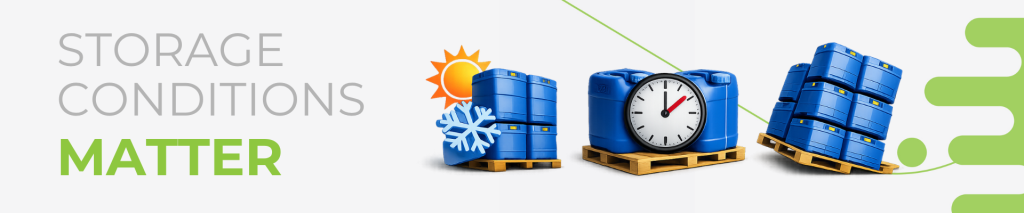
Storage & Environmental Factors That Influence Industrial Container Performance
Industrial containers are often selected based on capacity and material.
Less attention is given to how storage duration, temperature and handling conditions influence performance over time.
HDPE containers perform reliably within defined parameters.
Those parameters are influenced by environment and application.
Understanding these variables supports more accurate container selection.
Material Behaviour Changes Over Time
HDPE (high-density polyethylene) is widely used for industrial liquid storage due to its strength and chemical resistance.
However, like all thermoplastics, its behaviour is influenced by:
• Static load duration
• Temperature exposure
• Fill level
• Environmental conditions
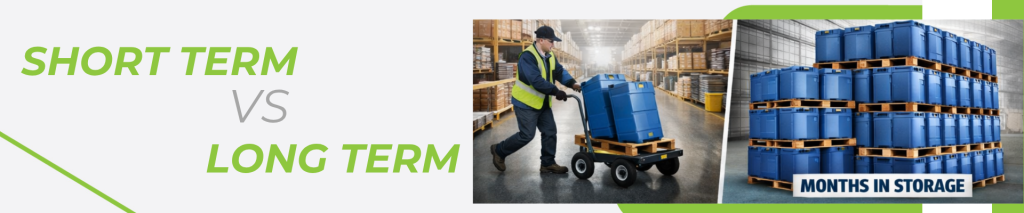
Short-term distribution storage is not the same as long-term warehouse stacking.
Extended static load can influence deformation over time, particularly at elevated temperatures.
Application context matters.
Storage Duration
There is a difference between:
• Containers moving through distribution within days
• Containers stored in a warehouse for several months
As storage duration increases, static load remains applied to the lower containers in a stack.
This does not automatically indicate failure.
It does mean performance expectations should reflect duration.
When reviewing container suitability, consider:
• How long the product will remain stored
• Whether stacking height changes during that period
• Whether pallets remain static for extended intervals
Storage duration should form part of variant selection.
Temperature Exposure
Environmental temperature influences HDPE behaviour.
Elevated temperatures can:
• Reduce stiffness
• Increase creep under load
• Influence closure performance
Containers stored in climate-controlled indoor environments will behave differently from those stored in high-heat warehouse conditions.
Where temperature fluctuation is significant, container selection should reflect that environment.
UV Exposure
Prolonged UV exposure can accelerate material degradation.
While many industrial containers include stabilisers, extended outdoor storage without protection may reduce service life.
If containers are stored outdoors:
• Duration should be limited
• Direct sun exposure should be considered
• Protective storage methods may be advisable
Indoor storage is recommended where practical.
Stacking Configuration
Stacking performance depends on multiple variables:
• Weight variant
• Fill level
• Pallet quality
• Load distribution
• Storage duration
• Environmental temperature
Maximum stack height cannot be determined by capacity alone.
It is influenced by variant selection and storage conditions.
Improper stacking, uneven pallet loading or overfilling may affect performance.
Selection should reflect the intended stacking configuration.
Handling Conditions
Performance is also influenced by:
• Manual handling practices
• Mechanical movement
• Impact during loading
• Transport vibration
Containers are designed for normal industrial handling conditions.
Dropping, impact or misuse may compromise structural integrity.
Handling procedures should align with container design intent.
Environmental Modifiers
Regardless of capacity, stacking limits may be influenced by:
• Elevated temperatures
• Long-term static load
• Uneven pallet loading
• Extended UV exposure
• Changes in product density
These modifiers do not automatically create failure.
They indicate that performance expectations should be aligned to application conditions.
Application Review
Container selection should consider:
• Substance formulation
• Concentration
• Storage duration
• Temperature exposure
• Handling configuration
Where operating conditions differ from typical distribution cycles, variant confirmation is recommended.
Final Consideration
Industrial containers are designed to perform within defined operating conditions.
Performance is influenced not only by what is stored inside the container, but by how and where the container is stored.
Structured variant selection, environmental awareness and application review reduce ambiguity and support long-term reliability.
If you are reviewing storage or stacking conditions within your facility, contact your sales representative to confirm that your current container variant aligns with your application.